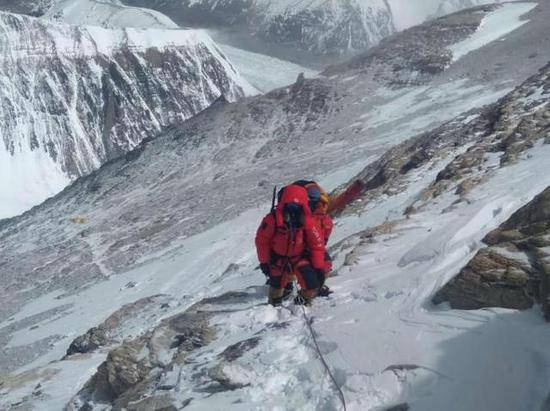
At 11 o'clock on May 27, Beijing time , the 2020 Everest Elevation Survey Summit Team successfully climbed to the summit of Mount Everest, completing China's seventh large-scale survey of Mount Everest. From 1966 to 2005, China conducted large-scale measurements on Mount Everest six times. The two sets of accurate data in 1975 and 2005 were recognized by authorities including the International UNESCO. Looking back at the six Mount Everest measurements also witnessed China has made a huge leap in the field of surveying and mapping.
When it comes to Mount Everest, the highest mountain in the world, it has always been a sacred place for challenging human limits. Although it is located on the border between China and Nepal, the first person to climb Mount Everest was not a Chinese. In 1953, New Zealand mountaineer Sheila Li and Nepalese tour guide Norgay became the first humans to successfully summit Mount Everest.
After the founding of the People's Republic of China, it also began to attempt to summit Mount Everest. Compared with the less difficult southern slope summit route, the northern slope of Mount Everest in China is considered an unconquerable route. At 4:20 on May 25, 1960, Chinese mountaineering team Wang Fuzhou, Gonpot and Qu Yinhua climbed to the summit from the north slope for the first time. The three people overcame the desperate situation of being without oxygen and running out of food for more than 20 consecutive hours and finally successfully planted the five-star red flag on Mount Everest.
Mount Everest measurements in 1966 and 1968
In 1966, Chinese surveying and mapping workers began to conduct on-site measurements on Mount Everest for the first time. The State Administration of Surveying and Mapping selected 19 people from the Second and Eighth Geodetic Survey Teams and Communications Teams to form a survey team and join the Chinese Academy of Sciences Everest expedition team. The altitude of the summit was measured for the first time from the north slope of Mount Everest, but the specific altitude measured this time has not been announced.
In 1968, a supplementary survey of Mount Everest was carried out. Based on the first survey data, the International Bureau of Surveying and Mapping assembled a 17-member team covering most of the first survey team members. In this survey, more observation stations were established on Mount Everest. The peak area has established a high level of high quality The survey and control network carried out work such as trigonometric, leveling, astronomy, gravity and powerless distance measurement, providing a basis for further accurate measurements of Mount Everest in the future. However, the two measurements did not establish a measurement battle mark on the summit, nor did they measure the peak. The ice and snow thickness and elevation data have not been released.
First precise measurement in 1975
In January 1975, the State Council and the Central Military Commission personally ordered that the third survey of Mount Everest officially began. The State Administration of Surveying and Mapping and the General Staff Bureau of Surveying and Mapping formed a large team of 49 people. At the same time, there was also a campaign to climb Mount Everest. They set off from the Rongbuk Monastery base camp on March 21, and on May 27, 9 team members successfully reached the summit at 14:30.
This time the summit measurement is of extraordinary significance. Based on the data established from the previous two measurements, a 3.52-meter-high red metal measurement battle mark was erected on the summit, and the snow on the summit was measured for the first time. Thickness, while measuring at nine observation stations located on three glaciers in the east, middle and west, the team members conducted zenith distance and horizontal observations together, in a rigorous scientific After calculation, the accurate altitude of the summit of Mount Everest was 8848.13 meters (0.93 meters of snow thickness has been subtracted) and announced to the world. This accurate data based on scientific measurements has been recognized by UNESCO and other countries around the world. , 8848.13 became the standard data in atlases and textbooks around the world for many years.
Two international cooperation retests in 1992 and 1998
In 1992, Chinese surveying and mapping workers cooperated with the Italian mountaineering team to conduct a re-survey of Mount Everest 17 years later. The First Geodetic Survey Team of the National Bureau of Surveying and Mapping undertook the field survey task. This survey began with plane control and leveling. , Tianwang and other measurements. At the base camp and the summit, GPS receivers were used to simultaneously receive and measure Mount Everest. In 1998, the First National Survey Team of China was invited by the United States to conduct a retest on Mount Everest again. However, due to the failure of the American mountaineering team to reach the summit, they were unable to conduct a summit rendezvous. In the end, only the triangulation method was used for the summit rendezvous. Both measurements were The height of Mount Everest has not been announced.
The most accurate elevation measurement to date in 2005
Since international mountaineering organizations and individuals organize climbs to Mount Everest every year, climbers only use simple GPS positioning to measure the height and continue to publish their measurement results to the world, seriously affecting the authority of China's 1975 Mount Everest elevation measurement results. In 2005, the State Administration of Surveying and Mapping organized a team to measure the height of Mount Everest and began China's sixth large-scale survey of Mount Everest.
Compared with the measurement in 1975, this time, 30 years later, more advanced technologies were used in the measurement, including previously unavailable equipment such as satellite positioning and snow depth detection radar, as well as traditional leveling, gravity, Using triangulation and other positioning methods, and with the support of various technical solutions, we successfully reached the summit on May 22, 2005. After careful calculations, the International Bureau of Surveying and Mapping officially announced the latest height data of Mount Everest on October 9, 2005. The altitude of the rock face at the top of Mount Everest is 8844.43 meters. It announced that the 1975 Everest elevation data of 8848.13 meters was officially discontinued.